If you work with Italian products abroad or manage supermarket assortments, you will eventually face a very practical decision: which extra virgin olive oil should actually be placed on the shelf.
This is not a trivial choice. Unlike other products, olive oil is largely based on perception. Customers rarely open the bottle before buying it. They make decisions based on price, packaging and, above all, on the olive oil brands they recognize.
For this reason, when people talk about the best olive oil, the answer is never straightforward. There is no single product that is objectively better than all others. Instead, some oils perform better within a specific context: a supermarket shelf, a target market, or a type of customer.
From the outside, a shelf simply looks like a selection of bottles. For professionals in the sector, it is the result of a precise balance between price positioning, brand strength, perceived quality and the ability to ensure consistent sales turnover.

This is where the real difference lies. The gap between a product that remains unsold and one that moves consistently is not only about quality, but about how that product is positioned and structured within the market.
This perspective is based on the experience of an Italian operator working daily with international retail and distribution, in close contact with buyers, importers and supermarket chains across different markets.
Bell Italia operates as a B2B partner for international retailers, supporting the selection and development of Italian food assortments tailored to diverse market needs. This direct exposure to shelf dynamics, consumer preferences and distribution requirements allows products to be evaluated not only in terms of quality, but also for their ability to perform consistently within the retail environment.
This practical approach — grounded in real market observation rather than theoretical rankings — is essential when analyzing Italian olive oil brands and understanding how they function within the supermarket context.
In the following sections, the goal is not to provide a generic list of the “best” products, but to offer a clear framework for understanding how extra virgin olive oil, brand positioning and real market performance are connected.
Article outline
- Production, availability and market dynamics
- Olive oil brands in supermarkets
- Pantaleo olive oil
- De Cecco olive oil
- Carapelli olive oil
- Clemente olive oil
- Desantis olive oil
- How to choose extra virgin olive oil
- Frequently asked questions
Italian extra virgin olive oil: production, availability and market dynamics
When talking about Italian extra virgin olive oil, one key factor must be considered: availability is no longer as predictable as it once was.
In recent years, production has become increasingly variable, influenced by structural factors such as climate conditions and plant diseases affecting olive trees. These elements directly impact both yield and consistency, making the overall supply less stable over time.
Italian olive oil continues to be highly valued in international markets, although its availability depends on several production and market factors. To better understand how these dynamics influence supply, pricing and distribution, you can explore this analysis on Italian extra virgin olive oil production and market dynamics.
One of the most visible consequences of this imbalance is the fluctuation of olive oil prices. Lower production volumes combined with strong global demand often lead to higher prices and reduced availability in certain periods.
For companies operating in retail and distribution, this scenario requires a more strategic approach. Products cannot be selected based only on origin or perceived quality, but also on their ability to guarantee continuity, consistency and supply reliability.
This is why, when evaluating olive oil brands in the supermarket context, it is essential to consider not only what is inside the bottle, but the entire system behind it — from production models to sourcing strategies and distribution capacity.
Olive oil brands in supermarkets: positioning and real performance
At this stage, it becomes clear that talking about the best extra virgin olive oil without considering the context is not very useful.
A supermarket shelf is not a ranking of better or worse products. It is the result of a balance between brand positioning, price levels and the ability to respond to market demand. This is why the most visible olive oil brands are not there by chance: each of them represents a specific production and distribution model.
For professionals working in retail and export, the focus is not on identifying a single “best” product, but on understanding which oils perform consistently on the shelf, ensuring rotation, recognizability and stability over time.
Some brands rely on strong distribution networks and global reach. Others are more closely linked to specific regions or production models. In every case, what matters is how these elements translate into real market performance.
This is why analyzing different Italian olive oil brands is not about creating a ranking, but about understanding how each product fits into the broader structure of the supermarket shelf.
Pantaleo olive oil
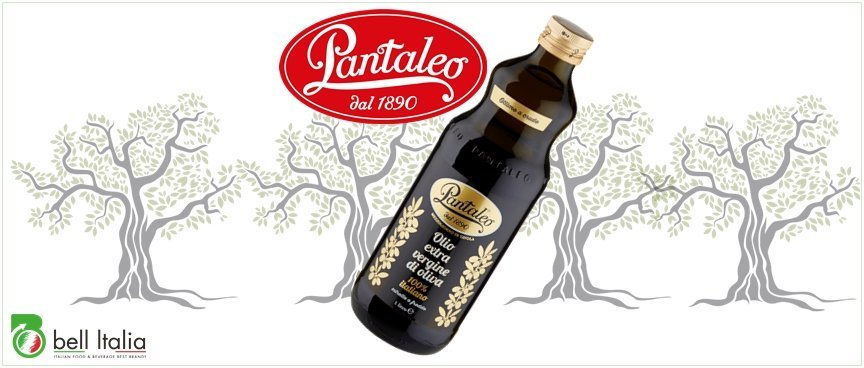
Among the Italian olive oil brands commonly found in supermarkets, Pantaleo represents a clear example for those working with international retail and distribution.
The company has deep roots in the Apulian olive oil tradition, with origins dating back to the late 19th century in the area of Fasano, one of the key production zones in Southern Italy. Over time, however, Pantaleo has undergone a fundamental transformation: moving from the sale of bulk oil to the development of a structured and recognizable brand.
Today, Pantaleo operates as an industrial player with the ability to manage large production volumes and supply both domestic and international markets. This aspect is particularly relevant in the supermarket context, where continuity of supply is just as important as product quality.
From a sourcing perspective, the model is mixed. The company combines part of its own production with a network of selected suppliers, allowing it to adapt to variations in raw material availability while maintaining product consistency — a key requirement for extra virgin olive oil in large-scale retail.
Traceability is another increasingly important factor, especially for international buyers. Pantaleo has implemented systems that make it possible to track the product along the supply chain, an element that is becoming more relevant in global markets.
In terms of sensory profile, Pantaleo oils typically offer a balanced but distinctive style. The fruitiness is usually medium, with vegetal and herbaceous notes, while bitterness and pungency are present but well integrated. This kind of profile works well in supermarkets, as it provides recognizability without being too strong for the average consumer.
From a positioning perspective, Pantaleo is neither a niche product nor an entry-level option. It sits in the middle segment, where customers perceive a reliable Italian olive oil with a clear identity and an accessible price point.
Export plays a central role in the company’s activity. A significant share of production is destined for international markets, with a strong presence in countries such as Japan, India and the Middle East. This makes Pantaleo particularly suitable for retailers building assortments of Italian products outside Italy.
Overall, Pantaleo represents a model that combines territorial tradition with industrial distribution logic, making it a consistent and scalable choice within the supermarket environment.
For retailers interested in this type of product, it is possible to explore the Pantaleo olive oil range adapted for international distribution.
De Cecco olive oil
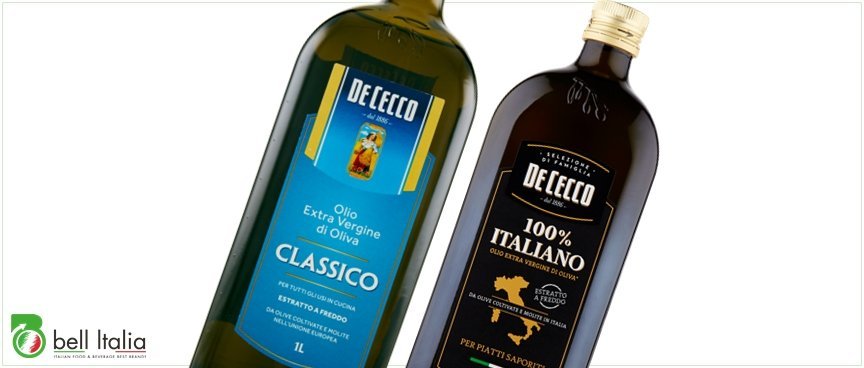
If Pantaleo represents a specialized olive oil producer, De Cecco follows a completely different logic. In this case, we are not dealing with a pure olive oil company, but with a large food brand that has built its reputation primarily in other categories, such as pasta.
This has a direct impact on how the product should be interpreted. When discussing De Cecco extra virgin olive oil, the key element is not the agricultural supply chain, but the strength of the brand. It is a name that consumers already recognize, and this familiarity plays a decisive role at the moment of purchase.
From a production perspective, the model is industrial. The company sources oils from different suppliers and creates the final product through strict quality control and blending processes, combining oils with different characteristics to achieve a consistent result.
Consistency is the core objective. In the supermarket environment, De Cecco offers a product that customers can expect to be stable and recognizable over time, regardless of batch or country of purchase. This is a key advantage in international retail, where continuity is often more important than origin specificity.
In terms of sensory profile, De Cecco olive oil is generally balanced and accessible. The fruitiness tends to be light to medium, with bitterness and pungency kept under control. This makes it suitable for a broad audience and for everyday use, without requiring a specific familiarity with more intense oils.
Within the supermarket context, this approach reduces uncertainty for the buyer. Customers are not simply choosing an olive oil, but a brand they already trust, which translates into stronger shelf rotation, especially in markets where Italian olive oil is not yet deeply established.
From a commercial perspective, De Cecco fits perfectly into the logic of large-scale retail: wide distribution, strong brand recognition and a price positioning that remains accessible while maintaining a perceived level of quality.
De Cecco represents a clear model: an olive oil built around brand identity rather than production origin, designed to deliver reliability, consistency and global scalability.
Carapelli olive oil
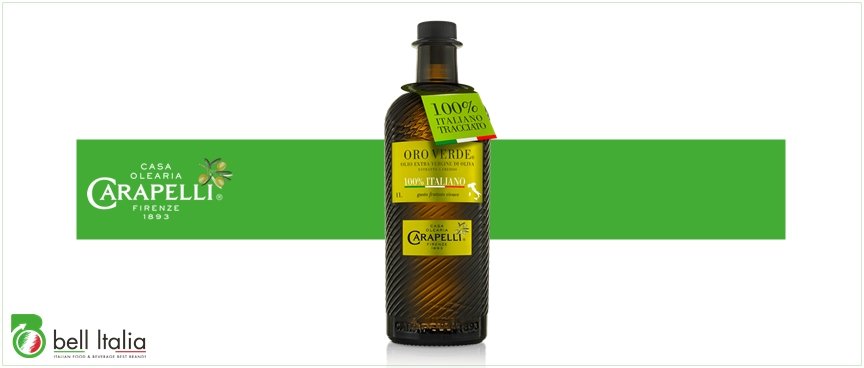
If De Cecco is primarily driven by brand strength, Carapelli represents a model closer to large international operators specialized in olive oil.
Carapelli is one of the historic names in the extra virgin olive oil sector, with origins in Tuscany dating back to the late 19th century. Today, however, it operates within a global industrial structure, combining a strong Italian identity with international distribution logic.
This dual nature is essential to understand the product. On one side, the brand maintains a clear association with Italian heritage. On the other, it relies on a broad and diversified sourcing system, where blending plays a central role in ensuring product consistency.
Through blending, Carapelli is able to deliver oils with stable sensory characteristics over time, regardless of seasonal variations. This is a key advantage in large-scale retail, where uniformity and reliability are critical factors for both buyers and consumers.
At the same time, compared to more standardized products, Carapelli has developed a range that includes different segments. Alongside core lines designed for everyday consumption, the brand also offers products with a stronger focus on origin or sensory profile. This allows it to cover multiple market positions while maintaining overall brand coherence.
In terms of taste, the most widely distributed Carapelli oils are typically balanced and versatile, with medium fruitiness and a profile that adapts easily to different culinary uses. In higher-end lines, a more complex structure can be found, although always within a framework designed for a broad consumer base.
Within the supermarket environment, Carapelli performs well because it combines two elements that are often difficult to balance: international recognition and a strong perception of Italian origin. For consumers, it is a familiar brand that still conveys a sense of authenticity.
For retailers and distributors, this translates into a product that can occupy multiple positions on the shelf, supporting both volume-driven segments and slightly more premium offerings.
Carapelli represents an evolved industrial model: a brand specialized in olive oil, rooted in Italian tradition but structured to operate on a global scale, capable of maintaining consistency while adapting to different market segments.
For retailers looking to include a globally recognized product with a strong Italian image, it is possible to explore the Carapelli olive oil range designed for international retail and distribution.
Clemente olive oil
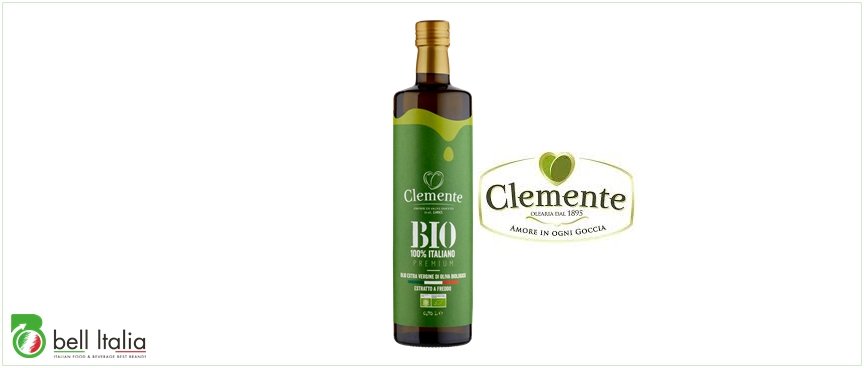
While the brands analyzed so far reflect industrial or brand-driven models, Clemente represents a different approach, much more closely connected to origin and supply chain.
This is an Apulian company with strong roots in the Gargano area, which has developed an industrial structure without losing its direct connection with olive cultivation. This is the key element that distinguishes Clemente within the landscape of Italian olive oil brands: a higher level of integration between agricultural production and the final product.
Unlike more globalized operators, Clemente maintains a significant part of its production within a limited geographical area. Olive groves, harvesting and processing are largely concentrated in Southern Italy, allowing for greater control over quality and traceability along the supply chain.
This production model directly impacts the oil itself. Rather than relying exclusively on blending strategies, Clemente products retain a stronger link to the varieties used. Cultivars such as Coratina, Ogliarola and Peranzana contribute to more distinctive sensory profiles compared to fully standardized oils.
From a sensory perspective, Clemente extra virgin olive oils tend to be more expressive and structured. The fruitiness can be medium to intense, while bitterness and pungency are often more pronounced, especially in oils rich in polyphenols. This makes them less neutral but more recognizable.
In the supermarket environment, this characteristic requires careful positioning. Clemente is not designed for every type of consumer, but for assortments that aim to include an olive oil with a stronger identity, capable of differentiating itself from more standardized products.
From a commercial perspective, the brand is typically positioned in a mid to upper segment, supported by a diversified range that includes organic and origin-focused products. This allows retailers to cover different needs while maintaining a consistent link to Italian production.
In international markets, this type of product performs particularly well when consumers are sensitive to origin, quality perception and product authenticity. It may be less immediate than global brands, but it can become a key differentiating element within a well-structured assortment.
Clemente represents a clear model: an Italian extra virgin olive oil with a stronger territorial identity, capable of bringing differentiation and depth to the supermarket shelf.
Desantis olive oil

Desantis represents a different model compared to the brands previously analyzed, one that is more closely aligned with the logic of large-scale retail focused on volume and accessibility.
The company originates from Apulia, in the area of Bitonto, and has evolved over time from a local mill into an industrial operator with a strong presence in supermarkets. This development reflects a clear positioning: providing reliable and widely available extra virgin olive oil designed to perform at scale.
From a supply chain perspective, the model is semi-integrated. Desantis works primarily with local producers in Southern Italy, while managing key industrial phases such as selection, blending and bottling internally. This approach offers a balance between maintaining an Italian origin and ensuring sufficient production capacity.
As with many oils aimed at large-scale distribution, blending plays a central role. By combining oils from different batches, the company is able to deliver a consistent product over time, which is essential when operating in multiple markets and at high volumes.
In terms of sensory characteristics, Desantis olive oils are typically positioned within a more accessible and easy-to-approach profile. The fruitiness is generally light to medium, with limited bitterness and pungency. This makes the product suitable for a broad consumer base and for everyday use.
Within the supermarket environment, this translates into a key advantage: the ability to ensure high shelf rotation, especially in price-sensitive segments where consistency and affordability are critical factors.
From a commercial perspective, Desantis follows a clear strategy: a wide product range, competitive pricing and strong distribution. Alongside extra virgin olive oil, the company offers different categories, allowing retailers to build a more complete and flexible assortment.
This makes Desantis particularly suitable for supermarkets that need to combine more distinctive products with options that can guarantee volume and continuity over time.
Overall, Desantis represents a classic large-scale retail model: an extra virgin olive oil designed for reliability, accessibility and consistent performance across different markets.
How to choose extra virgin olive oil in the supermarket
At this stage, the initial question takes on a different meaning. It is no longer about identifying the best extra virgin olive oil in absolute terms, but about understanding which product fits best within a specific retail context.
Supermarket shelves — whether in domestic or international markets — do not operate based on isolated excellence. They function through balance. Each brand occupies a specific position, shaped by factors such as brand recognition, production model, price positioning and ability to ensure consistent availability.
An effective assortment does not rely on a single type of product, but on a combination of different models. Global brands can offer stability and recognition, while more territorially linked oils can provide differentiation and identity. Volume-oriented products ensure rotation, while more distinctive ones elevate perceived quality.
For this reason, choosing an olive oil is not simply a matter of evaluating product quality, but of assessing whether it can maintain consistency over time, align with the target customer and support shelf rotation within the supermarket environment.
This is why understanding the differences between Italian olive oil brands becomes a practical tool. It is not about creating rankings, but about interpreting the market and building a range that performs effectively.
Ultimately, the difference is not made by the “best” product in theoretical terms, but by the one that achieves the right balance between perceived quality, price and distribution. This is where extra virgin olive oil becomes not only a product of excellence, but also a concrete commercial asset.
A well-structured assortment reflects the market itself. It is not just a collection of products, but a strategic combination designed to meet different needs while maintaining coherence and long-term performance. To explore a wider range of Italian products suitable for international retail, you can visit the Bell Italia catalogue for supermarkets and distributors.
Frequently asked questions about extra virgin olive oil in supermarkets
What is the best extra virgin olive oil?
There is no single “best” extra virgin olive oil. In the supermarket context, the most effective product is the one that combines consistent quality, strong brand recognition and appropriate price positioning for the target market.
How do you choose a good olive oil in a supermarket?
A practical evaluation should consider several factors: the brand, the production model, the origin and the price segment. A well-structured assortment usually includes different types of products rather than a single option.
Are olive oil brands important?
Yes. Each brand reflects a specific production and distribution model. Some focus on global distribution, others on origin and identity, and others on brand strength. These differences directly influence consumer perception and shelf performance.
Is supermarket extra virgin olive oil reliable?
In most cases, yes. Major brands in large-scale retail usually guarantee consistent quality standards, even though they may prioritize stability over strong territorial identity.
Is 100% Italian olive oil better than blended oil?
Not necessarily. A 100% Italian olive oil may offer stronger identity, while a blend can ensure greater consistency and availability over time. The choice depends on the positioning of the product and the expectations of the consumer.


